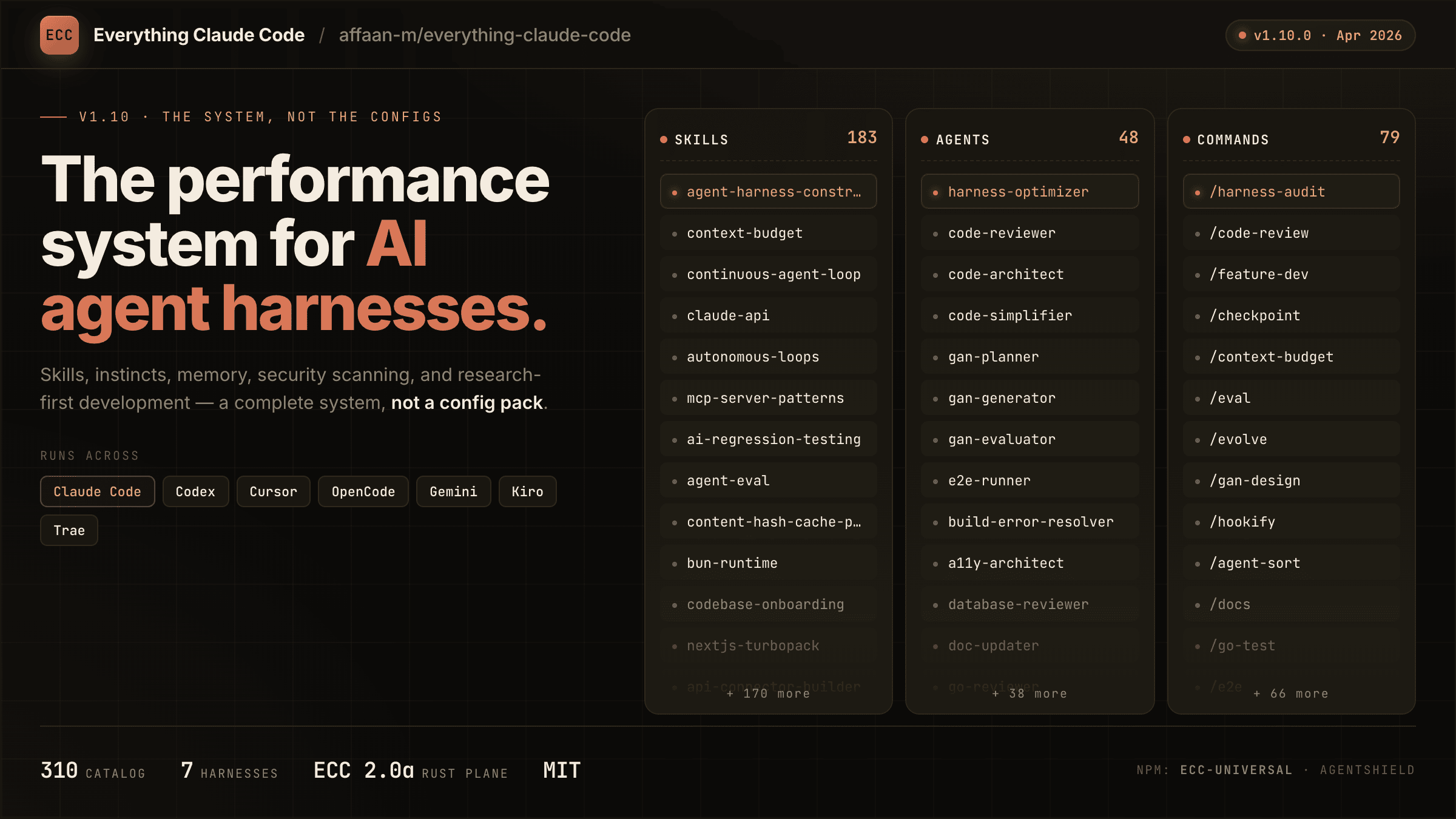
ECC
worthwhileA comprehensive harness-agnostic system that adds skills, memory, and security on top of base agents, but its sheer scope creates a steep learning curve.



What it is
ECC is a comprehensive agent harness operating system that provides skills, instincts, memory optimization, continuous learning, security scanning, and research-first development across multiple AI agent harnesses (Codex, Claude Code, Cursor, OpenCode, Gemini, Zed, GitHub Copilot). It includes a GUI dashboard (Tkinter), a Rust control-plane prototype, and npm packages like ecc-universal and ecc-agentshield.
How it differs from vanilla Claude
Vanilla agents can be prompted for many of these patterns individually, but ECC packages them into a cohesive system with persistent memory, security scanning, and cross-harness portability. The security features (AgentShield) and memory persistence hooks go beyond simple prompt engineering.
Skill, plugin, or workflow shift?
261 skills, 66 agents, 84 legacy command shims, memory hooks, security scanning, continuous learning loops, verification loops, parallelization support, subagent orchestration, operator workflows, prediction-market skills, optimization skills, and a Rust alpha control plane.
Devil's advocate — is this just complexity?
A vanilla capable agent like Claude Code can approximate many of these features with well-crafted system prompts and scripts. The memory persistence and security scanning add real value, but at the cost of massive complexity. For most users, a simpler setup with targeted prompts and a few shell scripts would achieve 80% of the benefit with 20% of the overhead. The claim of being an 'operating system' is marketing hyperbole; it's a collection of configs and scripts.
The honest case for it
For engineers who need to systematically manage agent workflows across multiple harnesses, ECC provides a battle-tested, community-validated framework that would take months to build from scratch. Its security scanning, memory persistence, and continuous learning features are genuinely useful and difficult to replicate with simple prompts. The cross-harness architecture is a real differentiator for teams that switch between tools.
Who it's for
Audience fit
Depth and leverage for a technical engineer who wants to understand it and level up their workflow — not just offload work.
Value for someone who wants a more capable tool without the technical depth — accessible, does-it-for-you.
Deep customization for multi-harness workflows is valuable for engineers who manage complex agent setups; vibe coders will find it overwhelming.