zvec
worthwhileA lightweight, blazing-fast in-process vector database with hybrid search, worth adding when you need local, low-latency similarity search without a server.


What it is
An open-source, in-process vector database library that stores and searches dense and sparse vectors, supports full-text search, and combines them in hybrid queries. It runs as a native library (C++) with bindings for Python, Node.js, Go, Rust, and Dart, and persists data via WAL. No server process needed.
How it differs from vanilla Claude
A vanilla Claude agent can write Python code using FAISS for vector search and SQLite FTS for full-text search, but it must manually manage the combination, persistence, concurrency, and performance tuning. zvec provides a single, unified API with built-in hybrid search, durable storage, and concurrent reads, all optimized in C++ — saving the agent from stitching together multiple libraries and handling edge cases.
Skill, plugin, or workflow shift?
Library — you import it into your Python/Node.js/Go/Rust project and use its API directly. It's not a plugin or skill; it's a dependency that replaces hand-rolled vector search logic.
Devil's advocate — is this just complexity?
A vanilla agent can already achieve the same functionality by combining FAISS (or any vector index) with SQLite FTS and a small amount of glue code. For most practical use cases, the performance difference is negligible, and the agent can adapt to changing requirements more flexibly. zvec adds complexity (a new dependency, C++ compilation issues on some platforms, version pinning) for marginal benefit. The 'one-minute example' is trivial; real-world usage requires understanding schema design, index tuning, and the hybrid query syntax anyway. Unless you're pushing extreme scale (billions of vectors) or need sub-millisecond latency, zvec is overkill over a simple FAISS + SQLite combo.
What would make it better
Better documentation on hybrid query tuning and real-world patterns. A higher-level API that auto-chooses index type based on data size. Cloud-native backup/restore stories. Support for GPU-accelerated indexing. A built-in embedding endpoint (like Chroma) to reduce the need for a separate model service.
The honest case for it
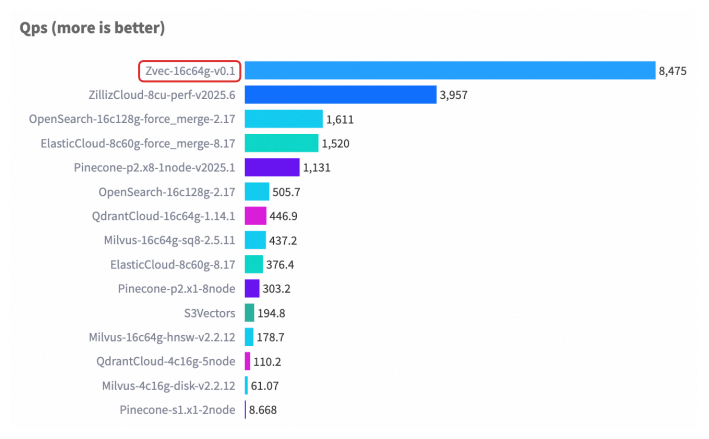
When you need a local, embeddable vector database that handles dense, sparse, and full-text search in one consistent API, with persistence and concurrency, zvec is a polished, production-proven choice. It's faster than anything you'd stitch together from scratch, and its multi-language bindings make it a solid foundation for cross-platform AI applications.
Who it's for
Audience fit
Depth and leverage for a technical engineer who wants to understand it and level up their workflow — not just offload work.
Value for someone who wants a more capable tool without the technical depth — accessible, does-it-for-you.
Delivers a production-grade, in-process vector DB with hybrid search that requires code to integrate, but minimal setup. AI engineers get deep leverage; vibe coders need to write scripts.