
J-Wash
nicheA local GUI playground for Jacobian-lens-based model editing, but exporting edited checkpoints is the only concrete advantage over a vanilla agent.

What it is
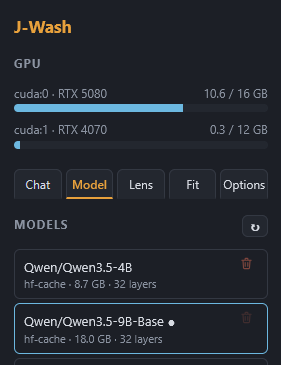
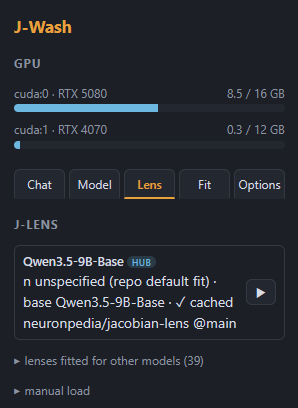
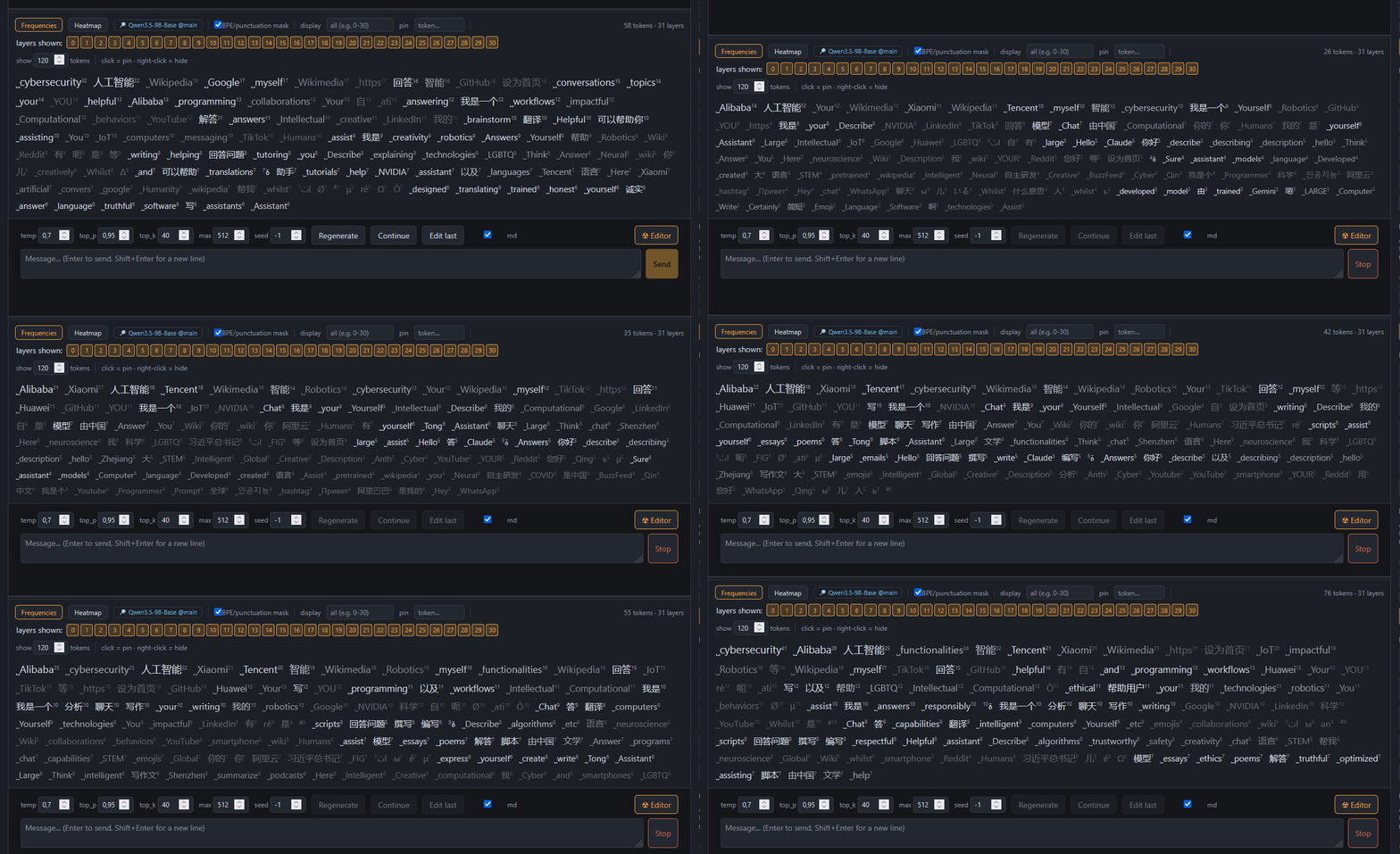
A local web app (FastAPI + React) that lets you load a Hugging Face decoder LLM, attach a Jacobian lens, chat with the model while visualizing per-layer token activations, apply edits like 'multiply token direction' or 'replace token' across chosen layers, and then export the modified model as a full checkpoint, modified layers, or LoRA — without training.
How it differs from vanilla Claude
A vanilla Claude can steer behavior via system prompts, few-shot examples, or tool use. J-Wash works at the level of residual-stream token directions: you directly manipulate the model's read projections, not its prompt/context. This allows edits that persist across sessions and export to a standalone model file, but requires deep interpretability knowledge and significant infrastructure.
Skill, plugin, or workflow shift?
Standalone-app — J-Wash runs its own server and UI, manages model loading, lens fitting, and editing state. It does not integrate into an existing IDE or agent workflow; it's a separate environment for model manipulation.
Devil's advocate — is this just complexity?
For 99% of use cases, a well-engineered system prompt in Claude will produce the same behavioral change as editing token directions (e.g., 'respond as a fish' vs. replacing the token ' model' with ' fish'). The extra complexity of installing CUDA tooling, cloning a lens repo, loading a full model, and running a React frontend only to achieve what a prompt can do is severe overkill. Moreover, the live preview only matches export in 'read projection' mode, and that mode is unavailable on Gemma-like architectures — so the core value proposition is fragile. Researchers studying interpretability may find the lens useful, but for day-to-day engineering, this is a heavy sledgehammer for a fly.
What would make it better
1) Provide a fully prebuilt binary (e.g., Docker image or standalone electron app) to eliminate the multi-step install process. 2) Add a library/API mode so the editing logic can be called programmatically without the UI. 3) Include a one-click comparison of edited vs. original model on a benchmark suite to quantify edit fidelity. 4) Support editing without a lens (e.g., simple activation steering) to lower the barrier to entry.
The honest case for it
If you need to surgically remove a specific behavior (e.g., refusal, bias) and export a permanent fixed model that loads in pure transformers without any extra code, J-Wash is the only off-the-shelf open-source tool that does this end-to-end with a visual interface. The Jacobian lens gives you a level of transparency into which layers encode which concepts that no prompt-based method can match, and the export pipeline is genuine — the edited checkpoint is a real model, not a runtime wrapper.
Who it's for
Audience fit
Depth and leverage for a technical engineer who wants to understand it and level up their workflow — not just offload work.
Value for someone who wants a more capable tool without the technical depth — accessible, does-it-for-you.
Deep interpretability tool for researchers/engineers who want to dissect and surgically edit LLM internals; entirely irrelevant for vibe coders who just consume APIs.