
factory-factory
worthwhileParallel agent sessions with isolated git worktrees and automatic PR progression – a useful orchestration layer, but setup-heavy and early-stage.

What it is
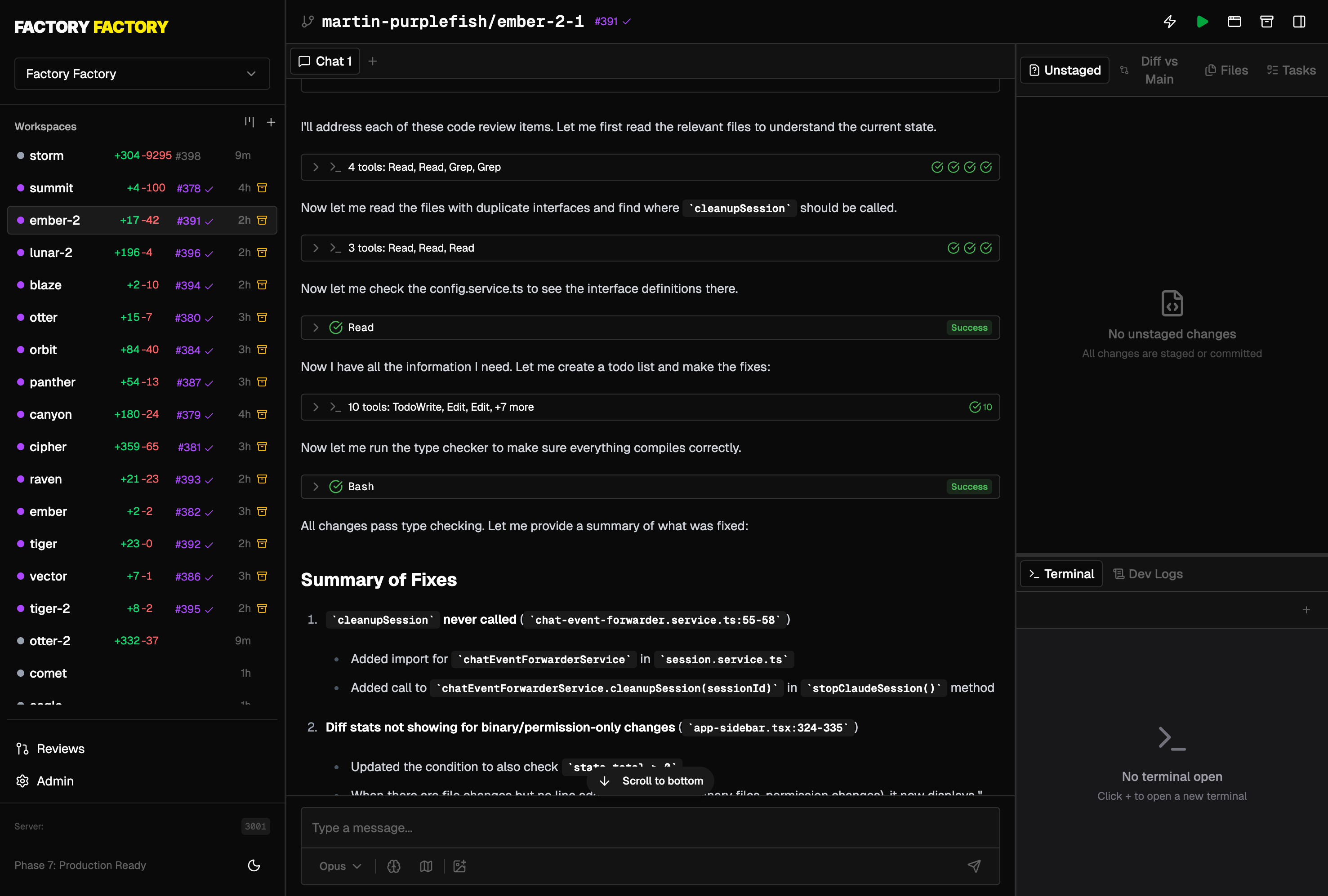
Factory Factory is a workspace-based coding environment that runs multiple Claude Code and Codex sessions in parallel, each in its own isolated git worktree and branch. It provides a web UI, CLI, Kanban board, and automatic PR progression (Ratchet) that monitors PRs and auto-fixes CI failures and review comments.
How it differs from vanilla Claude
A vanilla Claude Code session works on one branch at a time. Factory Factory orchestrates many sessions, each with its own branch, and can automatically progress PRs by spawning new agent sessions to fix issues. It also integrates with GitHub Issues and Linear for issue intake.
Skill, plugin, or workflow shift?
Large: requires Node.js 20+, GitHub CLI, Claude Code, optional Codex, optional Linear API key. Runs a web server with SQLite, WebSocket, ACP adapters, and optional Cloudflare tunnel. Configuration through admin UI and environment.
Devil's advocate — is this just complexity?
This is a lot of infrastructure for what is essentially a script that spawns multiple `claude` sessions in separate git worktrees. The Ratchet feature is clever but could be replicated with a simple cron job that runs `claude` on failed PRs. The Kanban board is a nice visual but not technically necessary. The project is early-stage (45 stars) and may not survive API changes in Claude Code or Codex. For a solo developer, the overhead likely outweighs the benefit. Teams with many concurrent features might find it useful, but they'd need to trust the agent to auto-fix PRs.
What would make it better
1) Reduce setup to a single command with Docker. 2) Add support for more agents beyond Claude Code and Codex. 3) Provide a simpler headless mode without the web UI. 4) Better documentation for security and isolation between workspaces. 5) More robust error handling when agents fail.
The honest case for it
Factory Factory solves a real pain point: managing multiple agent sessions across branches. The Ratchet feature is a step toward autonomous PR progression. If the project matures and gains adoption, it could become a standard tool for agent-driven development.
Who it's for
Audience fit
Depth and leverage for a technical engineer who wants to understand it and level up their workflow — not just offload work.
Value for someone who wants a more capable tool without the technical depth — accessible, does-it-for-you.
Requires technical setup and understanding of git worktrees and agent orchestration, but provides powerful automation for parallel development workflows.