
worldmonitor
marginalImpressive breadth and polish as a 65-API geopolitical dashboard, but an LLM agent can replicate most of the 'AI' curation with a few search calls — the delta
What it is
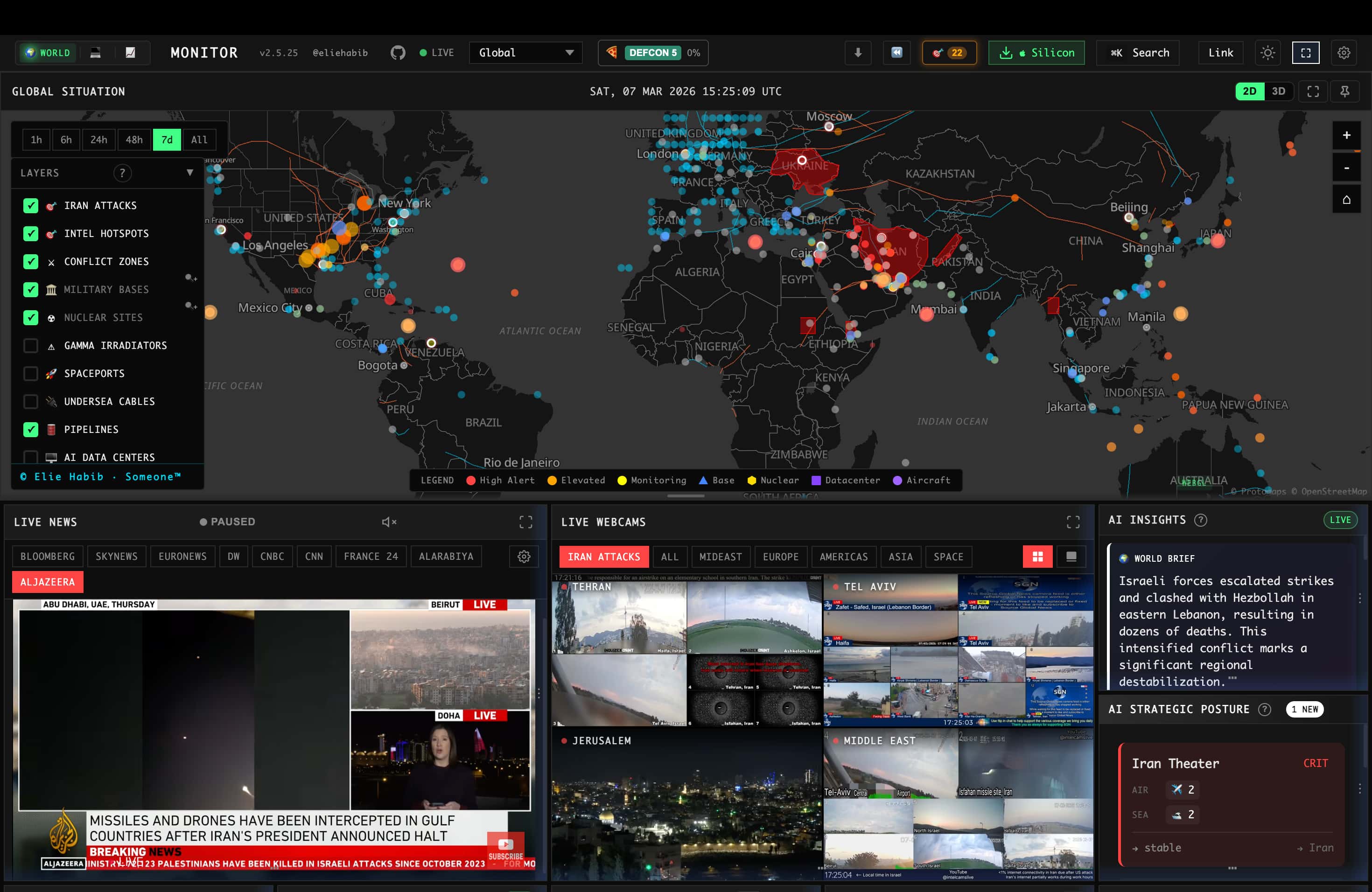
A fully self-hostable web and desktop application that ingests 65+ external data sources (news, social, financial, satellite, military) into a unified real-time dashboard with an interactive 3D globe, 56 map layer types, AI-generated briefs, and country risk scoring. Delivered as a single-deployment web app, a Tauri desktop binary, and programmable via MCP/REST/CLI/SDKs.
How it differs from vanilla Claude
A vanilla Claude can aggregate news, plot points on a map, and generate summaries — but it would need to be pointed at specific sources each time, wouldn't keep state, and wouldn't render a polished 3D globe with 56 interactive layers. This is a pre-bundled, stateful, persistent monitoring UI that runs continuously.
Skill, plugin, or workflow shift?
This is a standalone app that can also be scripted (MCP/CLI/SDKs), so it functions as both a product and a programmable endpoint. The integration is 'standalone-app' because the core value is the pre-assembled dashboard experience.
Devil's advocate — is this just complexity?
Most of the 'AI intelligence' here is summarization of RSS feeds and public APIs. An LLM like Claude with web search + a few lines of code can watch the same sources, generate briefs, and even use a map library — nothing in this repo is algorithmically novel beyond the pre-crawling and curation. The star count suggests many clicked 'watch' for the UI eye candy, not because this offers information a motivated agent couldn't fetch. The stack is enormously heavy (279 protos, Redis, multiple SDKs) for what is ultimately a news reader with a globe.
What would make it better
1) Publish the core risk-scoring algorithms (CII v8) as a lightweight open-source library or paper, decoupled from the UI. 2) Reduce the dependency surface to a deployable single-binary without Redis/Vercel. 3) Provide a simple plugin interface so users can add custom feeds without touching the monorepo. 4) Open the 'AI' model fine-tunes used for brief generation. Today it's a black box with a beautiful shell.
The honest case for it
If you need continuous, multi-theater monitoring without writing any glue code, and you value a polished, interactive map over a CLI pipeline, this saves days of setup. The MCP server and CLI make it genuinely agent-accessible. For analysts and journalists who aren't engineers, it's the only realistic way to spin up a globe+risk dashboard in minutes.
Who it's for
Audience fit
Depth and leverage for a technical engineer who wants to understand it and level up their workflow — not just offload work.
Value for someone who wants a more capable tool without the technical depth — accessible, does-it-for-you.
Massive dashboard with pre-built feeds and AI summaries strongly benefits a user who wants turnkey intelligence without coding. An engineer may value the MCP server and CLI for automation but the core value is in the curated UI/UX, not programmable depth.