
penguin-harness
worthwhileA harness that optimizes agent-building and self-evolution for cost savings, but unproven at scale and adds complexity over direct Claude usage.

What it is
A CLI and web UI harness that connects to 1000+ models, allowing users to build, run, and self-optimize AI agents with minimal code. It includes skills for data analysis, software engineering, and agent tuning, and claims to generate complete agent apps from a single sentence at very low cost.
How it differs from vanilla Claude
Vanilla Claude can build agents and write code, but PenguinHarness structures the process with a predefined harness, optimized tool calls, and a self-evolution loop. It aims to reduce token usage and cost compared to using Claude directly, and provides a web UI for observability.
Skill, plugin, or workflow shift?
Standalone-app because it provides its own CLI, web UI, and SDK; it is not a plugin or extension of an existing tool, but a complete environment for agent development.
Devil's advocate — is this just complexity?
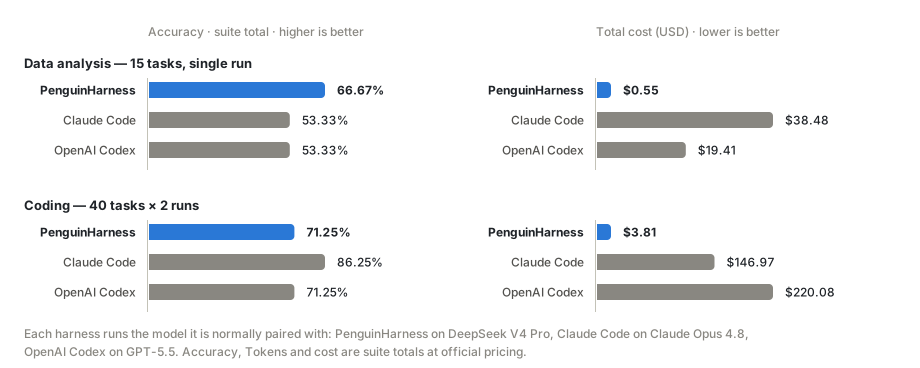
This is a classic 'prompt in a trench coat' scenario: the claims of self-evolution and cost optimization are suspiciously vague. A vanilla Claude agent can already run benchmarks, evaluate its own output, and iterate on improvements—just write a script. The harness adds complexity (Node 24, model config, web UI) for what is essentially a loop that Claude can already do. The benchmark comparisons are provided by the authors and not independently verified. Until the benchmark suite is public, these numbers are marketing. The 'one sentence builds a RAG app' example is impressive but likely heavily curated; vanilla Claude can generate similar code if prompted correctly. The self-evolution feature is just a feedback loop—something Claude can do with a simple prompt. The harness may actually increase overhead for users who already know how to use Claude effectively.
What would make it better
Publish the complete benchmark suite publicly so claims can be reproduced. Provide real-world case studies with independent verification. Simplify the installation to avoid Node 24 requirement (which is very new). Add a 'zero-config' mode that auto-detects the best model for a given task. Reduce the complexity of the web UI for simple use cases. Show more concrete examples of self-evolution actually improving performance over time (not just a video of a benchmark run).
The honest case for it
If the cost claims hold (1/70 of Claude Code for data analysis), this is a game-changer for budget-constrained teams. The self-evolution loop could automate the tedious process of prompt engineering and model selection. The single-sentence agent generation, if reliable, saves hours of boilerplate. The author's track record with LlamaFactory adds credibility. For AI engineers who want to build and optimize agents at scale, this harness provides a structured, observable framework that vanilla Claude lacks.
Who it's for
Audience fit
Depth and leverage for a technical engineer who wants to understand it and level up their workflow — not just offload work.
Value for someone who wants a more capable tool without the technical depth — accessible, does-it-for-you.
Engineers can leverage the harness for structured agent building and cost optimization; vibe coders may find the CLI and self-evolution appealing but the setup and model config requires some technical depth.